

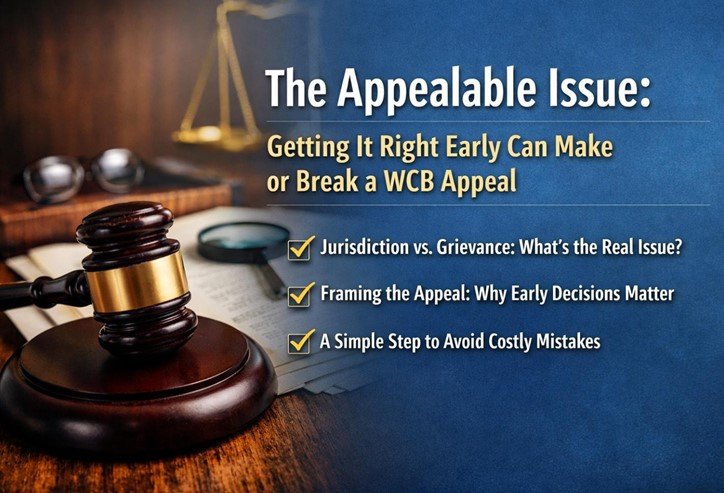
Why this matters more than most injured workers realize
When most injured workers think about appealing a WCB decision, they understandably focus on the outcome. They think about the benefit that was denied, the medical evidence that was overlooked, the restrictions that were misunderstood, or the feeling that the Board simply got it wrong.
But before any appeal body can decide whether a decision was wrong, there is a prior question that can be just as important:
What, exactly, is being appealed?
That question is not merely procedural. It goes directly to what the review body or appeal tribunal is actually allowed to decide. If the issue is not framed properly from the outset, a worker can spend months waiting for a hearing only to discover that the body hearing the appeal is not in a position to decide the full dispute the
worker thought was before it.
That can create confusion, delay, duplication, and unnecessary frustration. It is one of the more important — and often misunderstood — aspects of the workers’ compensation appeal process.
This article is about that problem: the appealable issue, why it matters, how misunderstandings can arise, and why it is so important to define the issue carefully and early.
What is the “appealable issue”?
In simple terms, the appealable issue is the specific question the decision-maker is being asked — and legally permitted — to decide.
That sounds simple enough, but in practice it is often where complications begin.
Workers naturally think in terms of their broader grievance. They may say, “WCB says I’m fit for work when I’m not,” or “they cut off my benefits unfairly,” or “they’re pushing me toward a job that makes no sense for me.” Those are real and legitimate concerns, but they are not always framed in the precise way the system requires.
Appeal bodies do not simply review the entire file and decide whatever seems unfair in a general sense. Their authority is narrower than that. They are confined to deciding the issue that has actually been raised,
adjudicated, and carried forward through the proper channels. If the issue is framed too narrowly, too broadly, or in a way that does not truly reflect the worker’s grievance, that can create real difficulty later on.
And once a matter is well into the appeal process, those difficulties are not always easy to correct.
The structure of the appeal process — and why framing matters early
In most workers’ compensation systems, a disputed WCB decision does not go straight to the final appeal tribunal. There is usually an intermediate level of review first. That body may go by different names depending on the jurisdiction, but the basic structure is familiar: an internal review or reconsideration process takes place before an external or independent tribunal hears the matter.
That matters because the issue starts taking shape long before the final hearing.
The worker files for review. The review body considers the matter and issues a decision. That decision then
becomes the platform for any further appeal. By the time the matter reaches the tribunal level, the issue is no longer infinitely flexible. It has usually already been defined, at least in substance, by the earlier stages of the process.
This is where many workers — and sometimes representatives as well — can get caught off guard. It is easy to assume that once a hearing is granted, the tribunal will simply hear the whole problem and sort it out.
Sometimes that assumption is close enough. But not always. Quite often, the tribunal is confined to the specific issue that was before the prior review body. It cannot necessarily expand the case to include every related concern, no matter how logical or compelling those concerns may be.
That is why the framing of the issue at the very beginning matters so much. If it is mishandled early, the consequences may not become apparent until much later, when a great deal of time and effort has already been invested.
The practical problem: when the worker’s grievance and the legal issue are not the same thing
This is the part that is rarely explained clearly enough to injured workers.
A worker may know exactly what is bothering them. They may know precisely what they want to challenge. But the way that grievance gets translated into an appealable issue is crucial, because the legal issue before the tribunal is not always identical to the worker’s broader sense of unfairness.
Sometimes the problem is that the issue was framed too narrowly. Sometimes it is framed too broadly.
Sometimes it is framed in a way that sounds close enough on paper, but turns out not to capture the actual dispute with enough precision. And sometimes two issues that seem closely connected are treated as though they are interchangeable when, in law and in process, they are not.
That last situation is especially common, and it can create significant problems.
A good example: fitness for work versus the suitability of a job lead
Take a worker who has gone through a supported job search. WCB identifies a particular job lead and takes the position that it is suitable. The worker disagrees.
From the worker’s perspective, the objection may seem straightforward: I am not suitable for that job because I am not fit for work at all.
To the worker, that feels like one problem. To the system, however, it may be two separate issues.
One issue is the suitability of the specific job lead. That question asks whether the identified occupation or position is appropriate in light of the worker’s vocational profile, background, skills, restrictions, and overall circumstances.
Another issue is fitness for work more broadly. That is a different question. It asks whether the worker is medically and functionally capable of working at all.
Those two issues may overlap. They may arise from the same facts. They may even feel practically inseparable from the worker’s point of view. But they are not necessarily the same issue in law or in administrative process.
That distinction can become critically important.
If the matter is framed only as a challenge to the suitability of the job lead, the tribunal may say it is not in a position to decide the broader question of whether the worker is fit for any work whatsoever. On the other hand, if the issue is framed only as general fitness for work, the tribunal may not be positioned to determine whether a specific job lead was vocationally appropriate.
The worker may arrive at the hearing expecting to argue both. The tribunal, however, may only have jurisdiction over one.
That is how confusion, duplication, delay, and sometimes repeat appeals can happen. One appeal does not fully resolve the dispute because the issue was framed too narrowly or imprecisely. Another appeal then becomes necessary. More months pass. More money may be lost. More frustration builds. All because the
issues were not properly identified and framed at the beginning in a way that truly matched both the worker’s grievance and the tribunal’s jurisdiction.
Why this is not just a technicality
Some may hear all of this and conclude that it sounds overly procedural or disconnected from the real-life problems injured workers face.
Unfortunately, it is not.
Workers’ compensation is an administrative system, and administrative systems are deeply shaped by
jurisdiction. A tribunal cannot simply decide whatever feels fair in the abstract. It must decide the issue that is actually before it. That means even a worker with strong evidence, credible treating doctors, and a compelling case on the merits can still run into serious difficulty if the wrong issue has been framed for review.
That is why this is not just a paperwork problem. It can materially affect entitlement, delay access to benefits, and force workers through repeated proceedings that might otherwise have been avoided.
In a system where workers are often already under financial, physical, and psychological strain, clarity around the appealable issue is not a minor matter. It can have very real consequences.
What workers and representatives should be doing differently
The first and most important point is that the appealable issue should never be treated as an afterthought.
When a request for review is first being prepared, careful thought should be given to what is actually being challenged. The issue should be framed in a way that is specific enough to identify the real dispute, but broad enough to remain workable if the evidence evolves or the medical picture becomes clearer over time.
That is not always easy to do. In more complex cases, it can be one of the most important strategic decisions in the entire appeal.
Workers and representatives should be asking questions such as: What is the true grievance here? What legal and policy question does that grievance actually engage? Does the wording leave enough room to deal with evolving medical evidence or related entitlement consequences? Am I challenging a specific determination, or something broader? Are there actually two distinct issues here that need to be separately raised and
adjudicated?
Those questions matter.
The review decision should also be read carefully once it is issued. Many workers read it only for the outcome, which is understandable. But it also needs to be read for how the issue itself was framed and decided. That framing may later define the legal boundaries of the tribunal’s jurisdiction. If the review body has framed the issue inaccurately or incompletely, that should ideally be identified as early as possible, not discovered for the first time on hearing day.
Why experienced representation can matter so much
This is one of the clearest reasons why experienced representation can matter in a WCB appeal, particularly where the issues are at all complex.
It is not just about writing submissions or speaking at a hearing. It is also about understanding how the system compartmentalizes disputes, how seemingly related issues may need to be separately adjudicated, and how to frame matters in a way that actually allows the worker’s real grievance to be properly heard.
A worker may know perfectly well that something is wrong. But translating that lived reality into the correct appealable issue is a different task altogether.
Getting that right early can save an enormous amount of time, confusion, expense, and avoidable procedural frustration later on.
A practical improvement worth considering
None of this is to suggest that appeal bodies are indifferent to fairness or unaware of the procedural
complexities involved in these cases. To the contrary, workers’ compensation appeals operate within real legal and administrative constraints, and those constraints are not always easy to navigate.
That said, there may be room for a modest procedural refinement that could help reduce unnecessary confusion in some cases.
One practical step worth considering would be a more proactive form of pre-hearing clarification. For example, several months before a scheduled hearing, the tribunal could issue a brief communication identifying the issue as it understands it and inviting the parties to confirm that the matter is properly framed for hearing.
Where a potential jurisdictional concern appears, a short pre-hearing conference or case management call might help clarify the scope of the appeal before hearing day arrives.
This would not require any major overhaul, nor is it suggested as a criticism of the current process. Rather, it is offered simply as a practical refinement that could help avoid the occasional situation where an issue-framing problem only becomes apparent once the hearing is already underway.
Given the length of time workers often wait for their appeals to be heard, even a small procedural safeguard of that kind could prove helpful. It could reduce delay, avoid unnecessary duplication, and improve the likelihood that the hearing ultimately addresses the dispute the worker is actually trying to resolve.
The bottom line for injured workers
If you are an injured worker navigating the WCB appeal process, the key point is this:
The issue your hearing is permitted to decide is not automatically the issue you want it to decide.
It is the issue that was framed through the review process, defined through the earlier decision-making stages, and carried forward into the appeal. By the time the hearing arrives, that issue may already be largely fixed.
That is why this work has to be done carefully and early.
When the case is simple, that may not create much difficulty. But when the case involves overlapping medical, vocational, entitlement, or return-to-work issues, the distinction can become critical. In those situations, getting the appealable issue right at the outset can mean the difference between a hearing that genuinely resolves the worker’s grievance and one that produces more delay, more confusion, and yet another trip through the system.
Where that kind of issue can be identified earlier, there is obvious value in doing so. A hearing is most useful when everyone arrives with a clear and shared understanding of the issue to be decided.
This article is for general informational purposes only and does not constitute legal advice. Every WCB claim and every appeal is different, and procedural rules vary by jurisdiction. If you are dealing with a specific appeal,
you should obtain advice from an experienced representative or lawyer familiar with the system in your province.