
Blue Collar Consulting represents both workers and employers across Canada. This is the story of one of our recent worker-side wins in BC.
A Blue Collar client we’ll call Nicole showed up for a cleaning job in Kimberley, BC last November. The gate at the property had come off its rail. She lifted it back into place and got on with her shift. She is five-foot-two and weighs about 110 pounds. The gate was over 100.
She felt a pull in her back, neck, and chest, especially on the right side. She texted her boss to flag what had happened with the gate. She didn’t call it an injury. She didn’t file a WCB claim that day. Her boss was a family friend, and the symptoms felt like the same shoulder business she’d been dealing with on and off for years.
She figured it would settle.
It didn’t. Two days later she was at the hospital. A month later she filed a claim. WorkSafeBC accepted it as a right shoulder and right cervical sprain/strain.
That’s where her employer got busy.
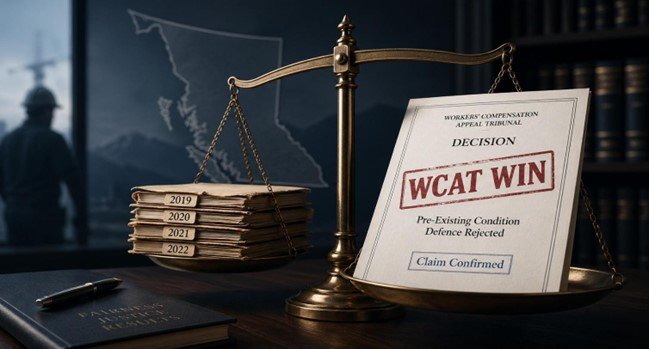
The employer asked the Review Division to overturn the acceptance. The Review Division said no. The employer appealed to WCAT. WCAT said no. Two losses on the same argument: Nicole already had a sore shoulder before the gate, so whatever she felt afterwards must be the old problem, not a new injury. The Vice Chair confirmed the claim in April 2026. The decision is final.
This case is a useful one to walk through because the employer’s argument is the single most common defence injured workers run into. She had it before. He’s always had a bad back. She’s just blaming work for something that was already going on. If you’ve dealt with WCB or WorkSafeBC for any length of time, you’ve heard some version of it. Sometimes you’ve heard it from the Board itself.
Here’s why it usually doesn’t fly, and why, when it’s argued well, it almost never should.
The Policy Doesn’t Care When Your Pain Started
The policy at the heart of this kind of case is straightforward. In British Columbia it lives in policy item C3-12.00 of the Rehabilitation Services and Claims Manual. It defines a “personal injury” as any physiological change resulting from some cause. That’s it. It doesn’t say the worker had to be perfectly healthy beforehand. It
doesn’t say the symptoms had to be brand new. It says: if your body changed, that’s an injury.
Alberta runs on a similar principle, though the policy is structured a bit differently and the tribunals have different names. The Workers’ Compensation Board, the Dispute Resolution and Decision Review Body, the Appeals Commission. Different acronyms, same logic. A pre-existing condition that gets aggravated,
accelerated, or made symptomatic by a work activity is still a compensable injury.
What that means in practice is the question is almost never “was this person perfectly healthy before they got hurt?” Because almost no one is. The honest question is whether the work incident caused a physiological change. If yes, the claim should be accepted. If the worker was managing fine before and can’t manage after, that’s a change. That’s the whole ball game.
WCAT got there by a clean route. The Vice Chair noted that Nicole had been working before the gate incident. Her shoulder had been giving her trouble for years, but she was doing her job. After the gate, she was at the hospital, off work, and her pain symptoms were materially worse. Her family doctor and her physiotherapist both documented the change. That’s a physiological change. That’s an injury. Done.
The Reporting Gap Was Not Fatal
The other piece the employer leaned on was the reporting gap. Nicole didn’t immediately frame the gate as a workplace injury. Her first text to her boss the day it happened mentioned the gate but didn’t say I hurt myself. Her hospital visit was two days later. Her formal claim was filed a month after that. The employer argued this was suspicious, that Nicole was building a story after the fact to attach pre-existing symptoms to a work event.
WCAT didn’t bite, and for good reason. The kind of immediate, formal injury report employers want to see is not how most injuries actually get reported in the real world. Workers wait to see if the symptoms settle. They don’t want to make trouble. They like their boss. They’re worried about their job. They figure the muscle pull will work itself out by the weekend. Sometimes they’re right. Sometimes they’re not, and a couple of weeks later they’re at the doctor wishing they’d said something sooner.
The Vice Chair took Nicole’s explanation at face value. The boss was a family friend, Carly didn’t want to start a workers’ comp claim, she eventually had to because the symptoms got worse. That’s not suspicious. That’s
normal.
WCAT also leaned on a guidance principle worth memorizing if you’re a worker or a rep. The worker’s
statement about her own condition is given weight, as long as it’s about something within her own knowledge, and a contrary conclusion needs a substantial foundation in clinical findings or other evidence to displace it.
The employer didn’t have one. They had a theory.
The Boring Stuff That Won the Case
There are three things Nicole did, almost certainly without thinking about it, that made her case basically airtight.
She texted her boss the day of the incident about the gate. That single text is doing enormous work in this decision. It locks in that the gate event happened, on that day, at that location. The employer didn’t try to deny the gate happened — they couldn’t — so the mechanism of injury was established before any lawyer or
advocate got involved.
She went to the hospital within 48 hours and the attending physician wrote down what she said happened. The hospital note from November 17 says she lifted a heavy metal gate two days earlier and tweaked her right collarbone with severe pain to the right side of her neck. That’s not Carly’s lawyer talking. That’s an emergency room physician documenting a contemporaneous report from a patient who was in pain.
Her physiotherapist, her family doctor, and eventually the Board’s own medical advisor all linked the worsening of her symptoms to the gate incident. Different practitioners, same story. Independent corroboration is the most boring evidence in the world and it wins more cases than anything else.
If you’re injured at work and you take nothing else from this article, take that. Send the text. Tell the doctor exactly what happened. Don’t dress it up, don’t dress it down, and don’t wait three weeks hoping it goes away. The contemporaneous record is what gets you across the line when an employer or a Board adjudicator decides to push back.
A Quick Word on What This Means in Alberta
This is a BC decision, so the binding effect lives in BC. But the principle WCAT applied, that a pre-existing condition doesn’t bar compensation when work activity causes a change in the worker’s condition, is alive and well in Alberta policy. We see versions of this fight every week at Blue Collar. An employer disputes claim
acceptance. The Board sometimes folds. The worker is left fighting for benefits they should never have had to argue for.
When that happens, the response is not legal sophistry. It’s organized evidence. A clean timeline. Medical documentation that links cause to effect. A worker statement that holds together because it’s true and
because it was given consistently from day one. That’s how Nicole’s claim was confirmed. That’s how most of these claims get confirmed when they’re handled properly.
The Real Lesson
The employer in this case spent ten months fighting an accepted claim on the theory that a sore shoulder is forever and any worsening must be the old problem catching up. They lost at the Review Division. They lost at
WCAT. The Vice Chair was polite about it, but the message was clear. Having a history is not the same as having an explanation, and WCAT is not in the business of pretending it is.
If you’re an injured worker, your old aches and pains are not the bar to your claim that your employer wants you to think they are. The system, when it works, knows the difference between a body that wasn’t perfect and a body that has changed. The trick is making sure the right evidence is in front of the right decision-maker, framed the right way.
That part doesn’t happen by accident.